
POPCORN KERNEL
A CAD kernel built so that changing your mind doesn't break your model. Every CAD program runs on a geometry kernel, the engine that holds the shapes and does the maths behind every cut and fillet. When CAD lets you down, with a fillet that won't build or a model that falls apart after a small change, the kernel is usually where it went wrong. Popcorn is a new kernel, written from scratch to make those failures rarer and to be straight with you about the ones that remain. It's in development, and this is what it's being built to do.
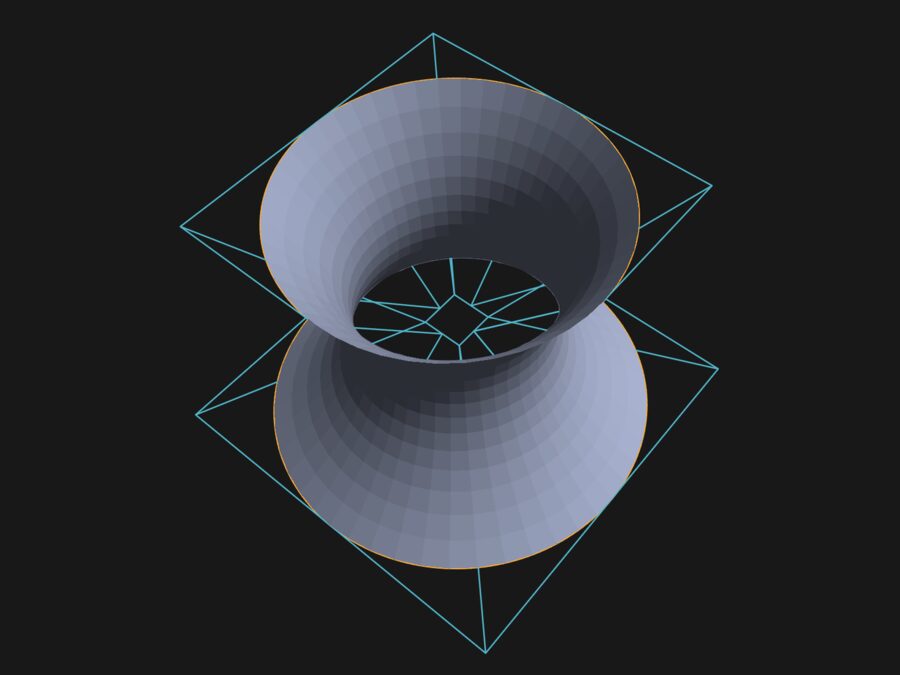
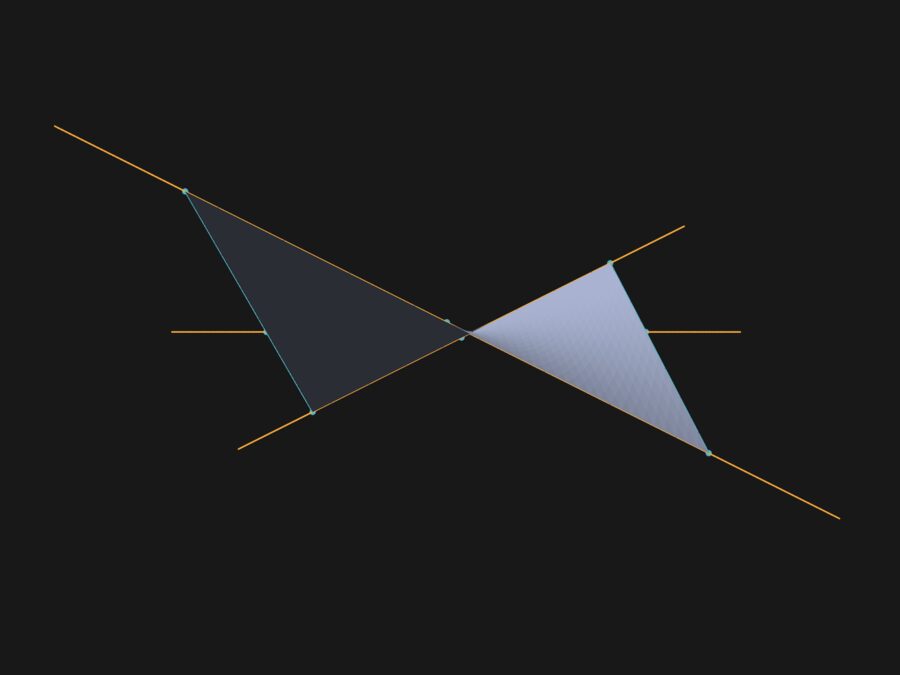
What it's built to do
- 0010Edits that don't break the model
Move a hole, and the fillet and the pattern that depended on it move with it. Popcorn tracks each face and edge by the feature that made it, so a reference keeps pointing at the right geometry after the shape around it changes. An operation that fails leaves the model exactly as it was before you tried.
- 0020Errors that tell you what to fix
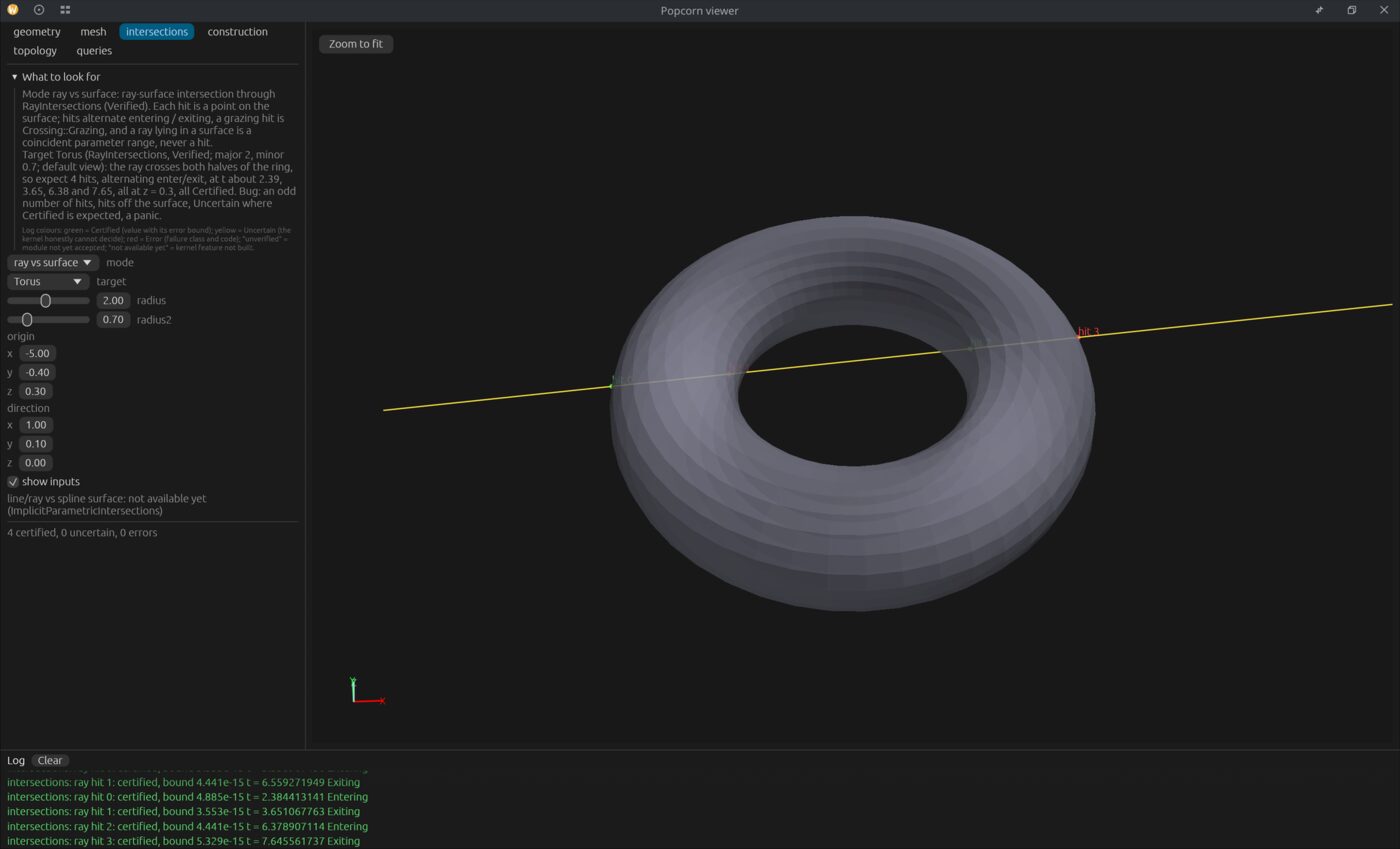
A ray through a torus. All four crossings come back certified, each with its error bound, and the viewer counts certified, uncertain and failed results separately. When an operation fails, Popcorn reports which faces were involved, what it tried and why it stopped. It also keeps apart geometry that can't exist, numbers too close to call, and cases it doesn't handle yet, so you know whether to change the design or try another way.
- 0030Accuracy you can check
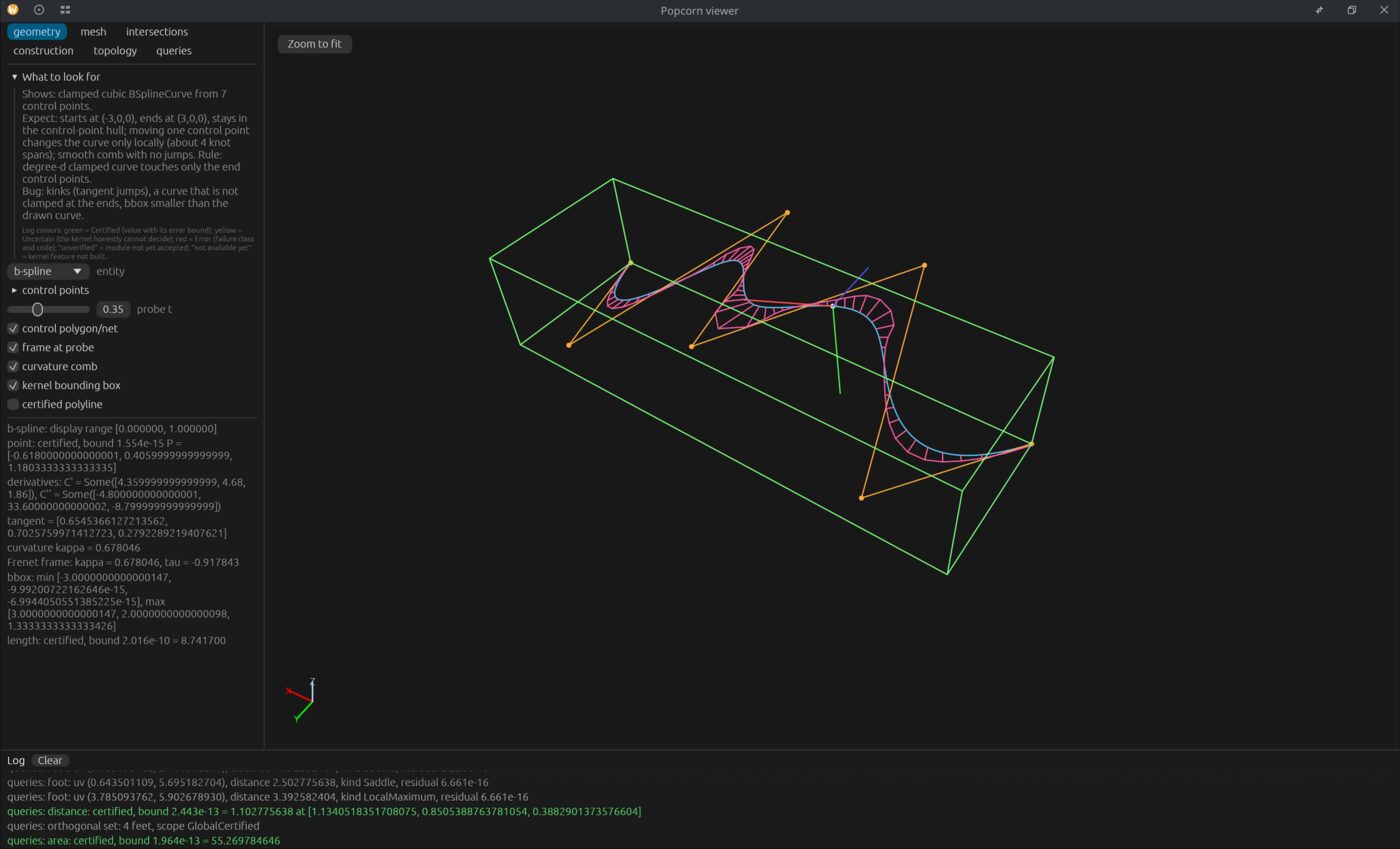
A spline curve with its curvature comb. Its length comes back certified, to within 2 × 10⁻¹⁰. A cylinder stays a true cylinder and a circle stays a circle, so they never drift into approximations of themselves. Where Popcorn does approximate, it records a verified bound on the error. It never widens a tolerance to push an operation through, and when ordinary arithmetic can't settle an answer, it brings in more precision before it commits to one.
- 0040The same result on every machine
A model rebuilds bit for bit the same on Windows, macOS and Linux, however many cores the computer has. A part that builds on your machine builds on your colleague's.
- 0050Solids, meshes and lattices together
Precise solids, scanned meshes and the lattices used in 3D printing usually need separate tools. Popcorn is designed to hold all of them, convert between them, and keep track of how exact each one is.
Written down before it's built
Every one of those behaviours is set out in a specification written in Piton, more than a thousand pages covering what each operation accepts, what it guarantees and how it fails. AI agents build the kernel from that specification, and each piece is audited blind by an agent that didn't write it. The same written contract makes Popcorn easy for agents to work with: an agent can read what an operation will do before calling it, and it gets failures back as data it can act on. It's the approach behind Strataglyph, applied to a CAD kernel.
Popcorn isn't available yet. Get in touch if you'd like to hear when it is, or go back to all works.